

In the years since the end of Northern Ireland’s violent conflict known as the ‘Troubles,’ language has been among the most contentious issues. The opposition of pro-British and mainly Protestant unionists to legislation promoting the Irish language was largely responsible for preventing the operation of a power-sharing government between 2017 and 2020. A compromise deal appeared to resolve the issue, but more disputes have arisen.
At present, one focus is on the demand for bi-lingual signage in the new Belfast Grand Central Station, and another on bi-lingual logos for the Belfast City Council. Controversies like these have the potential to contribute to another collapse of power-sharing. They are part of the wider culture war between unionism and pro-Irish ‘nationalism’ that has raged since the ‘Good Friday’ peace agreement of 1998.
Unionists believe that greater visibility for Irish in public life diminishes the British character of Northern Ireland, undermining their identity. Nationalists, however, hold Irish as central to their cultural and political identity. Although only a small number of people speak Irish as their main language, it is an important cultural symbol, not least because the language was suppressed over centuries by the British state in Ireland. Nationalists argue that the Good Friday Agreement, which provided for both power-sharing and intercommunal equality, means that the language should be on an equal footing with English, much as it is in the Republic of Ireland.
Amid this polarised situation, an unlikely project that views Irish as a vehicle of peacebuilding has flourished.
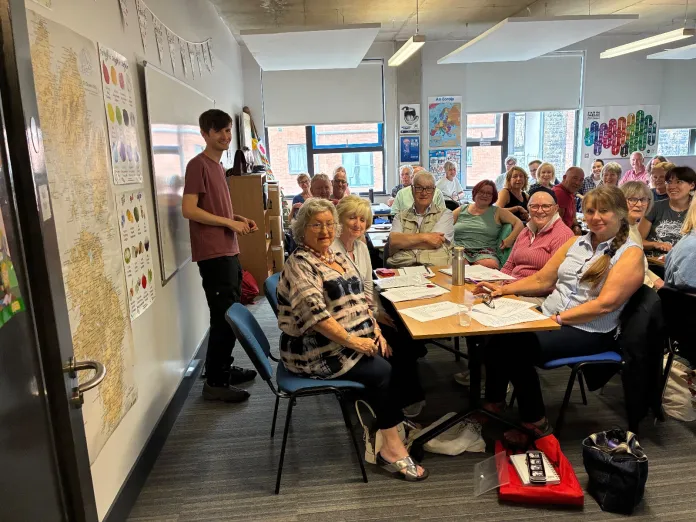
Turas, which means journey, is based in a working-class area of inner-city, and staunchly unionist, East Belfast. The surrounding streets are festooned with British and unionist paramilitary symbolism. Yet since its establishment in 2011, it has become the largest Irish language learning centre in Belfast, with hundreds attending its weekly classes. It is managed by the Methodist Church and based in the Skainos centre, a community hub built after the peace agreement. Funding has come from Foras na Gaeilge, a body set up under the Good Friday Agreement to promote Irish.
Much of Turas’s success and the attention it has garnered are attributable to its founder, Linda Ervine. She says she fell in love with the Irish language after taking a short course as part of a cross-community women’s group. Her interest deepened after she discovered that some of her East Belfast ancestors spoke Irish. She is the sister-in-law of the late David Ervine, a former loyalist paramilitary and politician who won widespread respect for his constructive role in the peace process.
Most of the learners at Turas are from a Protestant and unionist community background. Some are fearful of revealing their newfound interest to friends and family. But many are aggrieved that they did not have the chance to learn Irish before. As well as teaching the language, Turas has been active in raising awareness of how, historically, many Protestants spoke Irish, and that nearly all placenames in Northern Ireland, even in the most pro-British areas, are derived from Irish.
The project also runs a range of cultural events, trips to Irish speaking parts of Ireland, as well as local bus tours highlighting the forgotten Gaelic heritage of East Belfast. Turas’s offices host an Irish language library, open to the public. On the walls of the Turas classroom is a huge map of the streets of Belfast in Irish, and in large letters, the slogan, ‘ag foghlaim le chéile’ (learning together).
In September 2025, Turas realized a long-held ambition – to open an Irish language primary school in East Belfast. Scoil na Seolta (school of the sails) has faced opposition and threats. Some unionists believe that East Belfast is ‘their’ area and that an Irish language school is alien and threatening. But the school shows there is a demand for Irish language education. It is also the first Irish language ‘integrated’ school, meaning it stands apart from Northern Ireland’s mostly segregated education provision.
Overall, Turas promotes Irish as something that should not divide but that creates connections: between people and place, between unionists and nationalists in Northern Ireland, between the North and South of Ireland, and even between Ireland and Britain through Scots Gaelic, a language closely related to Irish.
Turas is firmly rooted in the context of Ireland. But there are wider lessons for peace work in other conflict zones about developing cultural projects which undermine polarised nationalist myths, and which are creative, inclusive, and based on an attractive sense of community.
It is hard to determine the societal impact of a single project such as this. Political unionism continues to oppose the Irish language, despite the long negotiations and some degree of agreement on the issue. But Turas is making a distinct contribution to easing the hostility of many unionists to Irish, and reframing the language as a symbol that can unite, not alienate.
By Dr. David Mitchell, Associate Professor, Conflict Resolution and Reconciliation, at Trinity College Dublin at Belfast.