

One of the most sobering lessons from the conflicts in the Great Lakes region is that, in international politics, moral arguments rarely determine outcomes. Interests do.
The Western world’s firm alignment with Israel, Europe’s solid support for Ukraine, and the political space that continues to exist for groups like the Forces démocratiques de libération du Rwanda (FDLR) inside the Democratic Republic of Congo (DRC) all illustrate a consistent pattern. This ground was founded by the perpetrators of the 1994 Genocide against the Tutsi in Rwanda.
States act when they have something to gain, and they look away when they do not.
The fate of M23, a movement that receives global condemnation but little genuine engagement, fits into this broader picture of selective solidarity and geopolitical double standards. To understand what is happening in the Great Lakes, it helps to look at how global powers behave in other regions.
International relations are not driven by sympathy or shared values alone; they are shaped by strategic value, security calculations, economic benefit, and geopolitical leverage. For instance, Western support for Israel and Europe’s commitment to Ukraine are rooted deeply in strategic interests, maintaining a foothold in a critical region and preserving the continental balance of power, respectively, far more than in moral arguments alone.
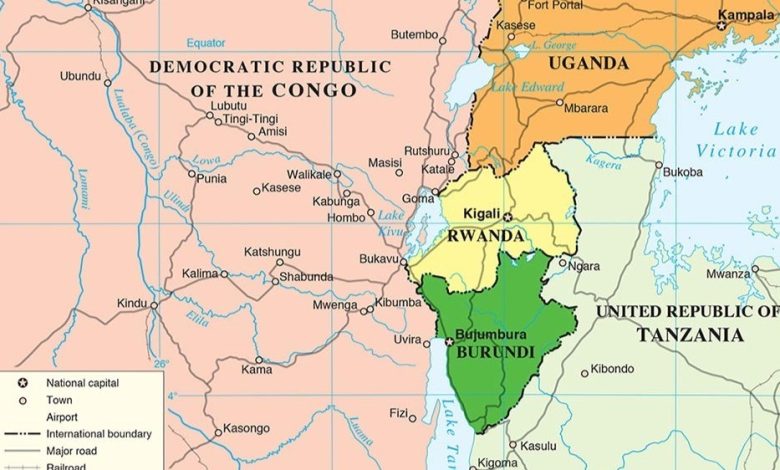
In the Great Lakes region, the permissive environment around the FDLR reveals how interests work at a local level, often at the expense of regional stability and human rights. For almost thirty years, the FDLR, posing an existential security threat to Rwanda, has maintained a presence in eastern Congo. Different governments have used the group as leverage, either to counter Rwanda or influence local dynamics, prioritizing short-term political and military advantage. This operational alliance is not just tolerated; it is actively supported.
The December 10, 2025, statement from the Republic of Rwanda explicitly condemns the coalition of the FARDC (Congolese Army) and the Burundian Army (FDNB) for systematically bombing civilian villages, using foreign mercenaries, and partnering with the FDLR and other genocidal militias, an accusation that the AFC/M23 has cited as the reason for its counteractions.
The statement further highlights the failure to neutralize the FDLR, as stipulated in regional peace accords, as a major obstacle to peace, demonstrating a deliberate regional policy that favors the continuation of the security threat against Rwanda.
This is the central contradiction. The world community insists on condemning and isolating M23, a movement whose origins lie in the long-standing, unaddressed grievances of Congolese Tutsi communities (Rwandophone Congolese) facing discrimination, exclusion, and insecurity. M23’s complaints are quickly dismissed and folded into geopolitical accusations, largely because the group does not serve the strategic interest of any influential global or regional actor. Condemning M23 is easy and cost-free.
The world speaks loudly and collectively to accuse Rwanda of supporting M23, while remaining largely silent on the active military support for the FDLR, a genocidal force that threatens Rwanda’s borders and stability, as detailed in the Rwandan government’s statement. This highlights a profound tolerance for a genocidal ideology operating as a regional proxy, while a persecuted ethnic group seeking protection is condemned.
The politics of the Great Lakes region have long been shaped by these overlapping, self-serving interests. Armed groups are not viewed through a moral lens but through one of utility: Some are tolerated and weaponized (FDLR), and others are ignored (M23’s grievances).
The hard truth is that without interests, nothing moves. The conflict teaches us that moral claims, no matter how legitimate, struggle to gain traction without an alignment of strategic benefit. Peace in the Great Lakes will not come from slogans, condemnations, or selective declarations. It will emerge only when regional, national, and international interests aligned in favour of stability and justice, starting with the unconditional neutralization of the FDLR and the sincere addressing of the legitimate grievances of the Congolese Tutsi community within the DRC.
Until then, the pattern remains clear: where there is no interest, there is no action. And where there is no action, conflict persists.
The writer is Dr. Joseph Ryarasa (via its X account), the Executive Director and Co-founder of Never Again Rwanda. He is A medical doctor with extensive experience in the clinical practice, Public Health, Peace Building and Human Rights.