 English
 Kinyarwanda

Rwanda: Fighting Corruption to Create Peace Dividends

High levels of corruption in any society undermine equitable and efficient resource distribution. Often, this results in inadequate funding for essential services, which can fuel public dissatisfaction and, in extreme cases, civil unrest.
For this reason, corruption is identified as one of the eight pillars of positive peace developed by the Institute for Economics and Peace.
The framework recognises that combating corruption is a critical peacebuilding tool, as low corruption creates peace dividends by strengthening trust in institutions, improving access to justice, and enhancing business efficiency and national competitiveness.
Rwanda appears to understand this connection well. The country has frequently been lauded for its commitment to fighting corruption at all levels of governance.
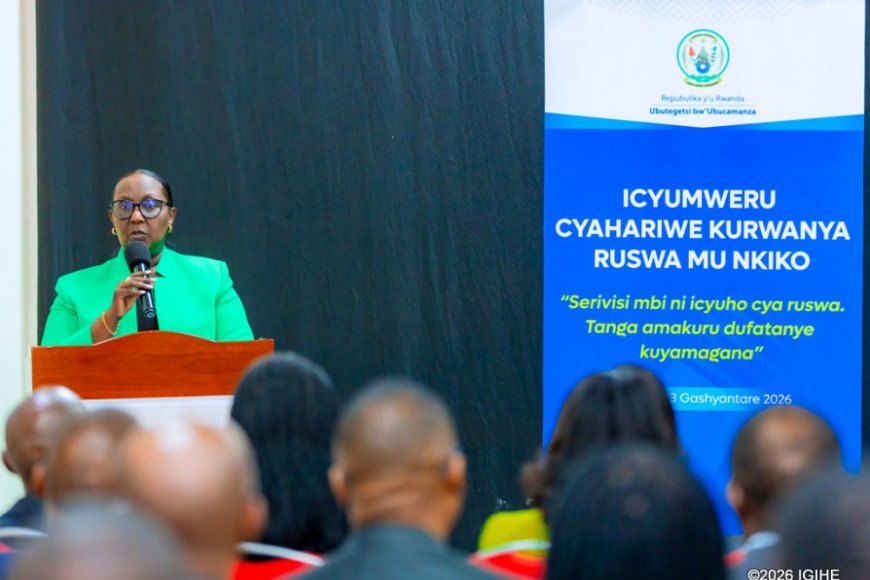
On 9 February, the Rwandan Judiciary launched its annual Anti-Corruption Judiciary Week, reaffirming its commitment to integrity and accountability within the justice system. The week-long initiative, which runs until 12 February, is held under the theme: “Poor service is a loophole for corruption. Report it and join the fight against it.”
The theme strongly aligns with another pillar of positive peace—well-functioning government—which emphasises that public institutions must serve citizens to the highest possible standards in order to strengthen transformative governance and social cohesion.
Poor service delivery often fuels corruption. Speaking at the launch, Chief Justice Domitilla Mukantaganzwa said the theme reflects persistent cases in which citizens resort to bribery to access services they are legally entitled to receive free of charge.
“We observed that corruption often arises when citizens pay for services that are their right,” Mukantaganzwa said. “We are calling on court users not to pay for their rights and to understand that justice is delivered based on the law, not money.”
She explained that the campaign aims to change mindsets—both among court users and judicial staff—and reminded judicial officers that quality service delivery is a duty, not a favour.
“Court officials must remember that serving citizens with integrity is part of their responsibility. The rights of court users are in their hands,” she said.
Mukantaganzwa also cautioned the public against individuals who claim that justice can only be obtained through bribes, urging citizens to report poor service whenever it occurs.
“People should not believe those who tell them they must pay to get justice. When someone experiences poor service, it should be reported so that action can be taken.”
Corruption Cases in the Judiciary
Judicial officials revealed that 13 individuals within the judiciary were punished for corruption-related offences during the 2024/2025 period. Over the past two decades, 57 members of judicial staff have faced disciplinary sanctions.
Mukantaganzwa stressed that corruption within the judiciary will not be tolerated.
“Justice is a right delivered strictly based on the law. It has no price,” she said, adding that integrity must be upheld across the entire justice chain.
She warned that corruption erodes public trust in an institution expected to uphold the highest ethical standards and protect citizens’ rights. She also cautioned that bribery offers no lasting advantage.
“You may bribe your way through lower courts, but you will not sustain it all the way to the Court of Appeal or the Supreme Court. At some point, you will be caught,” she said, calling for collective commitment to end both giving and receiving bribes.
RIB Data on Corruption Across Sectors
Deputy Secretary General of the Rwanda Investigation Bureau (RIB), Consolee Kamarampaka, disclosed that between July 2022 and June 2025, RIB recorded 1,822 case files involving 3,448 suspects. About 70 per cent of the cases involved embezzlement, while 30 per cent related to bribery.
She noted that 46 per cent of suspects were public servants, 53 per cent were from the private sector, and 1 per cent were from non-governmental organisations.
During the same period, authorities recovered and seized more than Rwf 1 billion and over USD 100,000 in bribery-related cases, while more than Rwf 36 billion was recovered from embezzlement cases.
Kamarampaka further revealed that between 2018 and 2025, 73 RIB staff were prosecuted, with 50 dismissed from service.
She added that preventive measures include rotating investigators every three years, strengthening inter-institutional cooperation, and regularly updating complainants on the status of their cases.
Chief Justice Mukantaganzwa reminded stakeholders that fighting corruption is a shared responsibility. “Justice is a right delivered based on the law. There is no price for it,” she said. “Fighting corruption is a shared responsibility across the entire justice chain.”
High levels of corruption weaken institutions and undermine several pillars of positive peace, including equitable distribution of resources, a sound business environment, acceptance of the rights of others, high levels of human capital, and the free flow of information.