 English
 Kinyarwanda

Rwanda Targets 10,000 Refugee Repatriations in 2026 Under New Road Map

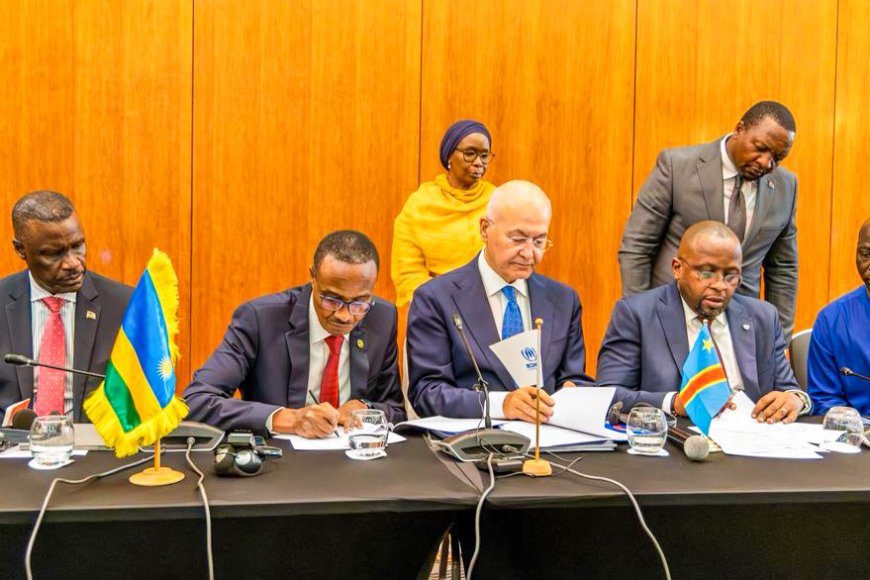
The governments of Rwanda and the Democratic Republic of the Congo (DRC), alongside the United Nations High Commissioner for Refugees (UNHCR), agreed on Monday to a new operational road map targeting the voluntary repatriation of 10,000 Rwandan refugees in 2026.
According to the joint communiqué, the agreement was reached during a high-level ministerial meeting held in Addis Ababa-Ethiopia on June 22, where officials adopted a joint operational road map to safely return displaced populations.
The newly approved “2026-2027 Tripartite Technical Working Group Road Map on Voluntary Repatriation and Reintegration” establishes operational milestones, responsibilities, and timelines for implementation, monitoring, and review.
This agreement builds directly on late 2025 political developments, specifically the “Accords for Peace and Prosperity” signed between the DRC and Rwanda in Washington on December 4, 2025.
Official data shows that both nations continue to host large numbers of displaced people.
The DRC currently hosts 196,289 Rwandan refugees and asylum seekers, with 75,421 successfully registered through biometrics. Meanwhile, Rwanda hosts 84,456 Congolese refugees and asylum seekers.
Voluntary returns have steadily gained momentum over the last 18 months.
A total of 8,394 people have successfully repatriated in safety and dignity since January 2025, including 2,347 individuals who have already returned home so far in 2026.
To achieve the 10,000-person target this year, the cross-border strategy will deploy specific transit infrastructure.
The parties agreed to utilize the border-crossing point connecting Kamanyola in South Kivu, DRC, to Bugarama, Rwanda.
This route is set to “facilitate the voluntary, safe, and dignified return of over 3,600 Rwandan refugees currently dispersed over a large geographic area of the southern part of South Kivu Province who have expressed a willingness to repatriate to Rwanda.”
To support this route, the DRC committed to establishing a viable transit route for candidates coming from various southern locations. Meanwhile, Rwanda acknowledged the ongoing challenges faced by “over 400 Rwandan refugees who have been waiting for over a month for voluntary repatriation in transit centres in North Kivu and South Kivu.”
The ministers also addressed the upcoming return of Congolese refugees living in Rwanda.
Though these specific repatriations have not yet launched, the parties agreed that starting in October 2026, the DRC will provide priority areas of return using location data and intention surveys provided by Rwanda.
The ministerial talks followed preparatory work managed by a technical working group from June 20 to 21.
Moving forward, the entities will launch formal quarterly cross-border meetings, either in person or virtually, starting in September 2026 to coordinate logistics. The next high-level ministerial session is scheduled to take place in June 2027.
The operational frameworks respect long-standing legal pillars, tracking back to the original bilateral agreements signed on February 17, 2010. The plan also aligns with the 1951 Convention Relating to the Status of Refugees, its 1967 Protocol, and the 1969 OAU Convention Governing the Specific Aspects of Refugee Problems in Africa.
According to the communiqué, Kigali committed to continue receiving returnees while taking into consideration the prevailing public health situation and Ebola-related guidelines.