 English
 Kinyarwanda

Can silent wounds ever truly heal? Rwanda’s women journey through genocide trauma

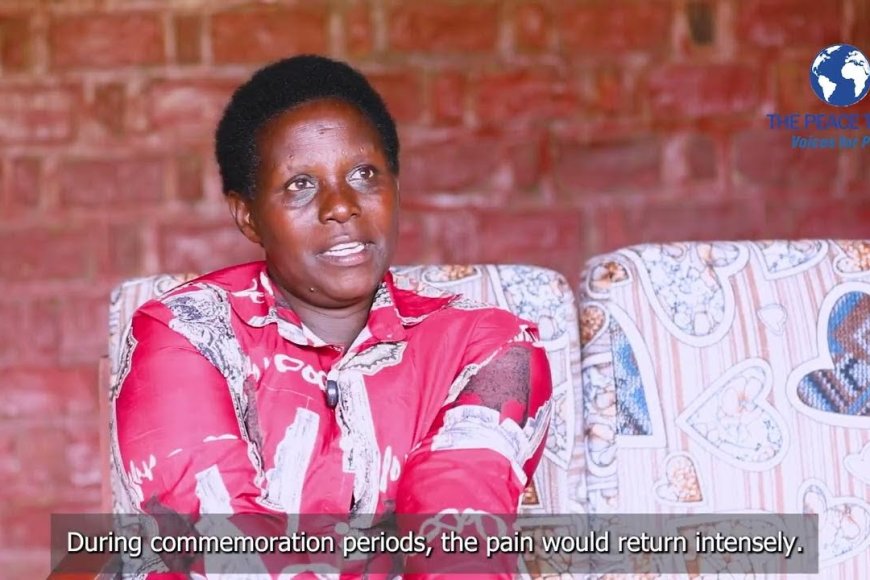
In the Bugesera District of Eastern Rwanda, Mukaremera Francoise witnessed the killing of her family during the 1994 Genocide against the Tutsi. In a harrowing betrayal, she was raped by a man who had promised her safety. Despite these immense horrors, Mukaremera overcame the trauma, emerging more resilient than ever.
In April 1994, Francoise Mukaremera was an 18-year-old bride, only days into marriage, when the world she knew in Bugesera District, Eastern Province collapsed into a systematic hunt for Tutsi.
In Bitega Village, Musovu Cell, Julu Sector, she watched as her family was hunted down and killed. She fled for her life, carrying with her memories no one should ever have to bear.
Her journey through the 1994 Genocide against the Tutsi was defined by devastating loss. Nine members of her family were killed at Nyamata Catholic Church, while others perished in different places. For decades, the weight of that loss remained a silent, private heavy burden.
Mukaremera crossed into the Democratic Republic of the Congo to escape killers, but continued to live in fear. Even in refugee camps, she was targeted by those who identified her as Tutsi.
When she finally returned to Rwanda, she found that only one sibling—her brother—had survived among all her nuclear and extended family members. But her brother was left disabled by the brutal attacks he endured.
Watch her short testimony:
“I was mute with anger,” she recalls. “I had lost everyone, my parents, my extended family, and the only relative I found was my disabled brother. I felt such extreme pain that if I had a gun, I would have shot anyone I met, believing everyone was complicit.”
Trauma took hold of her life. Sleep became impossible. Night after night, she relived the killings, sometimes in dreams, sometimes in waking flashes that felt like a horror film playing in her mind.
For years, she clung to denial, telling herself that those whose burial places were unknown might still be alive. Accepting their death felt unbearable.
The heavy weight of sexual violence
Rape was used systematically as a weapon during the genocide. An estimated 250,000 to 500,000 women were subjected to sexual violence during those 100 days, leaving deep, invisible wounds. Many survivors continue to struggle with post-traumatic stress disorder (PTSD), depression, anxiety, isolation, and, in some cases, suicidal thoughts.
Mukaremera is one of them.
While fleeing toward Gitarama - now Muhanga, she was raped by a man who had promised to hide her. The betrayal left more than physical scars, it buried her in shame and silence that lasted long after the genocide ended.
“The rape weighed heavily on me; I felt a deep sense of shame,” she says. “I wondered, if I told a man this, could we ever live together?”
Even as she tried to rebuild her life and start a family, the past seeped into her present.
She became easily angered, often taking out her pain on her children. When they asked about their grandparents, she could not find the words—only tears instead of responding to them. Her marriage, too, suffered, as she misread her husband’s actions through the lens of her trauma, often misinterpreted them as a lack of care.
Every April, during the genocide commemoration period, the pain returned with overwhelming force. She could not find the courage to join others at the Nyamata Genocide Memorial or any other commemoration site.
“For seven days, I would stay in bed with a persistent headache,” she says. “I couldn’t cook. I couldn’t watch TV. I didn’t want to hear or see anything that reminded me of the atrocities.”
Finding a way back to life
Her turning point came when she joined the Mvura Nkuvure ( loosely translated “heal me I heal you”) – a Sociotherapy programme, introduced in her community by Interpeace in partnership with Prison Fellowship Rwanda, working closely with the Ministry of National Unity and Civic Engagement (MINUBUMWE).
The programme brought together survivors and perpetrators in small groups, creating a space for truth-telling, accountability, shared healing, and reconciliation, a process that last for around three months.
At first, the idea of sitting side by side with perpetrators was almost unthinkable. But something shifted after a few sessions.
“They started mixing us, placing a survivor next to a perpetrator,” she explains. “I heard fellow survivors speak about their pain, and perpetrators acknowledge their crimes. That’s when I began to open up.”
For the first time, she spoke about her own suffering, including the rape she had kept hidden for years.
“I felt a need to unburden myself,” she says. “We all shared our stories. I realised we were all hurting in different ways, and we began to comfort each other.”
arious healing programmes have been implemented across the country to support national efforts toward healing, foster reconciliation, and strengthen the resilience of Rwandans.
Today, Mukaremera’s life tells a different story. She has healed from her trauma. She is now a proud mother of four and a caring grandmother of two.
“My children and grandchildren have become my strength. They have, in many ways, replaced the family I lost. I no longer feel the same loneliness. Every morning, I wake up with a clear purpose - to work hard, provide for them, and build a better future for my family. Before, I didn’t have the strength or courage to work.”
Once overwhelmed by trauma, anger and despair, she has become a leader in her community. She now serves as a representative of the National Women Council at the cell level and as vice president of her local cell.
Her health has improved. She sleeps. She speaks openly with her children about the history that once silenced her.
“Before, I felt I had no human heart,” she reflects. “I was filled with self-hatred, and when you hate yourself, you cannot love others. Now, I have love.”
Mukaremera’s story is not only a testimony to the horror of the genocide, it is also a powerful reminder of resilience.
More than three decades later, Rwanda continues to live with the consequences of its past. Yet within that reality, stories like hers show that even the deepest wounds, though never fully erased, can begin to heal when they are finally spoken.
Watch Mukaremera's full testimony here: