 English
 Kinyarwanda
DRC Army Spokesperson’s Hate Speech Raises Alarm Over Fragile Peace Deal, Rights Group Says
A senior Congolese army official’s televised remarks targeting the Tutsi community amount to genocidal hate speech and can undermine a newly signed peace agreement between the Democratic Republic of Congo (DRC) and Rwanda, according to a detailed analysis by the civil society organisation Never Again Rwanda (NAR).
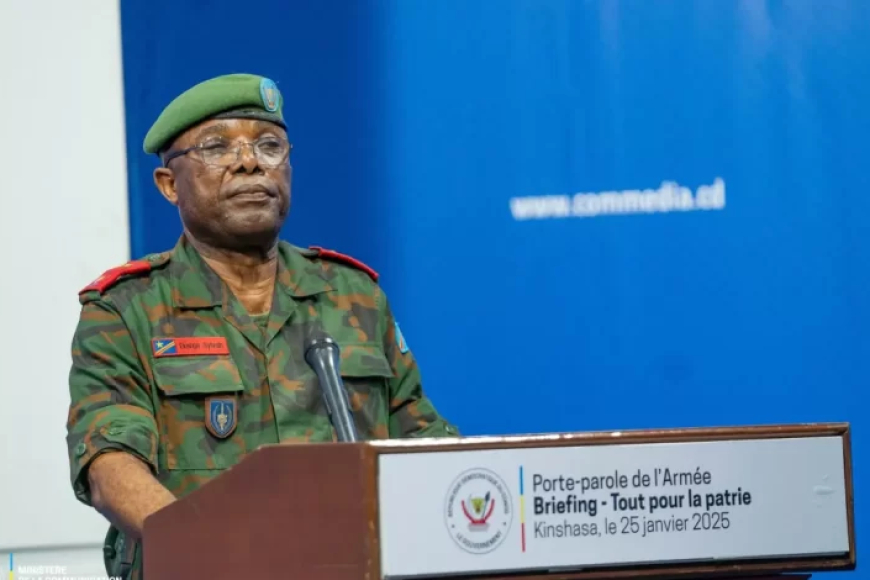
The incident occurred on December 27, 2025, just three weeks after Presidents Félix Tshisekedi and Paul Kagame signed the Washington Accords for Peace and Prosperity, a U.S.- and Qatar-brokered framework aimed at ending decades of conflict in eastern DRC. Appearing on state broadcaster Radio-Télévision Nationale Congolaise (RTNC), FARDC spokesperson Major General Sylvain Ekenge warned Congolese men against marrying Tutsi women, portraying them as agents of “infiltration” used to maintain ethnic superiority.
Never Again Rwanda says the remarks were not spontaneous. General Ekenge appeared to read from prepared notes, while the television host actively reinforced the narrative, suggesting “institutional coordination rather than individual misconduct.” Although the DRC government suspended both General Ekenge and the host two days later, the organisation argues that the response was “cosmetic” and fails to address deeper, systemic anti-Tutsi discrimination within state institutions.
According to Never Again Rwanda, the broadcast directly violated provisions of the Washington Accords and related agreements, including the Luanda Process Concept of Operations, which explicitly requires an end to hate speech and verbal attacks. The accords also commit both countries to protecting civilians without distinction and respecting international human rights and humanitarian law.
“At its core, the Washington Accords depend on trust and good faith implementation,” the report notes, warning that broadcasting hate speech through official state channels during the early implementation phase “fundamentally undermines confidence in the process.”
The peace deal was designed to halt fighting that escalated sharply in 2025, when the M23 rebel group seized major cities including Goma and Bukavu, displacing nearly one million people and killing thousands. M23 claims to defend Congolese Tutsi communities from discrimination and violence, a claim Kinshasa rejects.
Echoes of genocidal ideology
Never Again Rwanda analyses General Ekenge’s remarks using Dr. Gregory Stanton’s “Ten Stages of Genocide” framework, concluding that the rhetoric exhibits characteristics of at least seven stages, including classification, discrimination, dehumanisation, polarisation and preparation.
The spokesperson’s portrayal of Tutsi women as deceptive tools of demographic conquest, and of Tutsis as foreign “Nilotic” conquerors, echoes colonial-era racial theories and propaganda used ahead of the 1994 Genocide Against the Tutsi in Rwanda, the report says. “This is not merely offensive speech,” it argues, but “advanced genocidal ideology being promoted through official state channels.”
While the broadcast did not explicitly call for violence, Never Again Rwanda warns that such messaging increases risks for civilians by legitimising suspicion, discrimination and potential attacks on Tutsi communities, particularly women and children.
Congolese civil society groups condemned the remarks. The pro-democracy movement Lucha called for sanctions against General Ekenge, while also noting that such rhetoric reinforces the grievances cited by armed groups claiming to protect threatened communities.
Rwanda reacted sharply. Foreign Minister Olivier Nduhungirehe described the broadcast as evidence that the Kinshasa government was “sinking into genocidal horror,” explicitly comparing the rhetoric to the Hutu Ten Commandments used ahead of the 1994 genocide. M23 issued its own statement calling the remarks “genocidal propaganda.”
Western responses were more muted. Belgium’s foreign minister said he was “extremely shocked,” while the United States, the main mediator of the Washington Accords, did not issue a public statement. The United Nations, despite its peacekeeping and civilian protection mandate in the DRC, also remained publicly silent.
Suspension “not enough”
Never Again Rwanda says that suspending two individuals after the fact does little to mitigate harm already caused. The message was broadcast nationwide on prime-time television, and deleting the video later “prioritised international image management over domestic accountability,” the report says.
More importantly, the organisation contends that structural discrimination remains unaddressed. It points to the continued targeting of Tutsi communities by state-backed militias, impunity for anti-Tutsi violence, the integration of elements linked to the FDLR militia into security structures, and the absence of high-level political leadership condemning discriminatory rhetoric.
“A genuine accountability process would examine who approved, scripted and facilitated the broadcast,” the report states. “That has not happened.”
The organisation concludes that unless the DRC government undertakes concrete reforms, covering military discipline, media oversight, civilian protection and accountability, the Washington Accords risk joining a long list of failed peace initiatives in the Great Lakes region.
“The Ekenge incident should be treated as an early warning,” Never Again Rwanda says. “Whether it becomes a turning point for prevention or another ignored signal preceding further violence depends on choices made now.”
For civilians in eastern DRC, the stakes are high. As the report warns, “advanced genocidal rhetoric appearing on state television is not a minor implementation hiccup—it is a grave test of the peace process and the international community’s commitment to prevention.”