
Experts Call for Stronger Regional Cooperation to Address Cross-Border Insecurity in the Horn of Africa

Experts Call for Stronger Regional Cooperation to Address Cross-Border Insecurity in the Horn of Africa

Mar 16, 2026 - 23:58
 0

Security experts and practitioners gathered on Monday 15 March for a regional dialogue hosted by the Horn of Africa Institute for Peace and Security, warning that growing cross-border insecurity across the Horn of Africa requires stronger cooperation between governments, institutions and border communities.


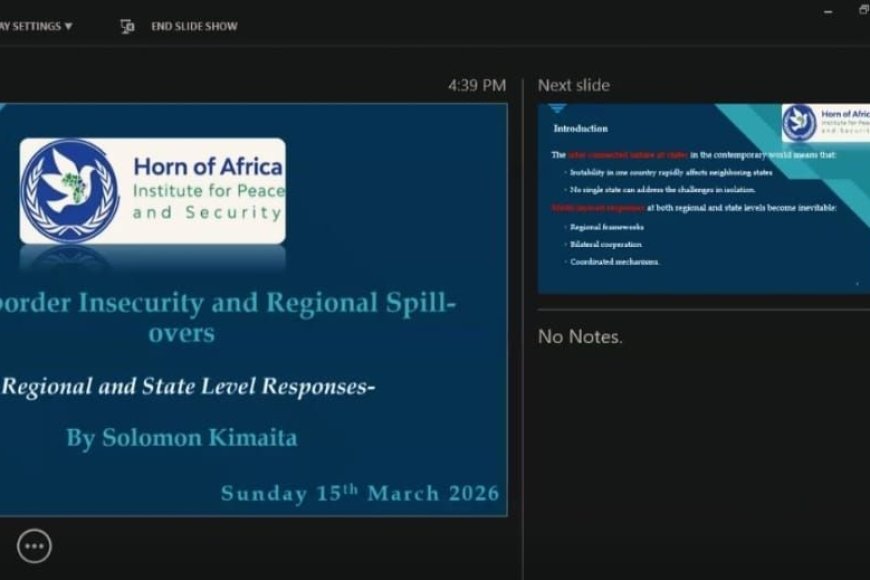
The virtual discussion took place during the institute’s PeaceTalks+ session titled “Cross-Border Insecurity and Regional Spillovers,” which brought together participants from across the region to examine how conflicts, illicit trade networks and armed groups increasingly operate beyond national boundaries.

Speakers highlighted how transnational criminal activities, ranging from trafficking in natural resources to the movement of armed groups, are fueling instability and allowing conflicts to spill over into neighboring countries.

Banao Fawzi Yves pointed to the growing role of illicit cross-border trade networks and resource trafficking in sustaining armed groups and spreading insecurity across borders.

Meanwhile, Solomon Kimaita stressed the importance of coordinated regional responses, noting that stronger cooperation among states and regional organizations will be essential to tackle evolving security threats.

Participants agreed that cross-border insecurity has become a shared regional challenge that cannot be addressed by individual countries alone. Instead, they emphasized the need for more integrated border governance systems and policies that place greater focus on human security in border communities.

The dialogue concluded with several policy recommendations, including strengthening regional cooperation mechanisms, improving border management frameworks, tackling illicit trade and small-arms trafficking, and increasing institutional capacity and funding for regional security initiatives.

Participants also highlighted the importance of engaging communities living in border areas, arguing that local populations often play a critical role in identifying risks and building sustainable peace across borders.


Experts Call for Stronger Regional Cooperation to Address Cross-Border Insecurity in the Horn of Africa

Mar 16, 2026 - 23:58
 0
Experts Call for Stronger Regional Cooperation to Address Cross-Border Insecurity in the Horn of Africa

Security experts and practitioners gathered on Monday 15 March for a regional dialogue hosted by the Horn of Africa Institute for Peace and Security, warning that growing cross-border insecurity across the Horn of Africa requires stronger cooperation between governments, institutions and border communities.


The virtual discussion took place during the institute’s PeaceTalks+ session titled “Cross-Border Insecurity and Regional Spillovers,” which brought together participants from across the region to examine how conflicts, illicit trade networks and armed groups increasingly operate beyond national boundaries.

Speakers highlighted how transnational criminal activities, ranging from trafficking in natural resources to the movement of armed groups, are fueling instability and allowing conflicts to spill over into neighboring countries.

Banao Fawzi Yves pointed to the growing role of illicit cross-border trade networks and resource trafficking in sustaining armed groups and spreading insecurity across borders.

Meanwhile, Solomon Kimaita stressed the importance of coordinated regional responses, noting that stronger cooperation among states and regional organizations will be essential to tackle evolving security threats.

Participants agreed that cross-border insecurity has become a shared regional challenge that cannot be addressed by individual countries alone. Instead, they emphasized the need for more integrated border governance systems and policies that place greater focus on human security in border communities.

The dialogue concluded with several policy recommendations, including strengthening regional cooperation mechanisms, improving border management frameworks, tackling illicit trade and small-arms trafficking, and increasing institutional capacity and funding for regional security initiatives.

Participants also highlighted the importance of engaging communities living in border areas, arguing that local populations often play a critical role in identifying risks and building sustainable peace across borders.