 English
 Kinyarwanda

Rwanda warns against repeating 1994 Genocide mistakes at Vienna Conference
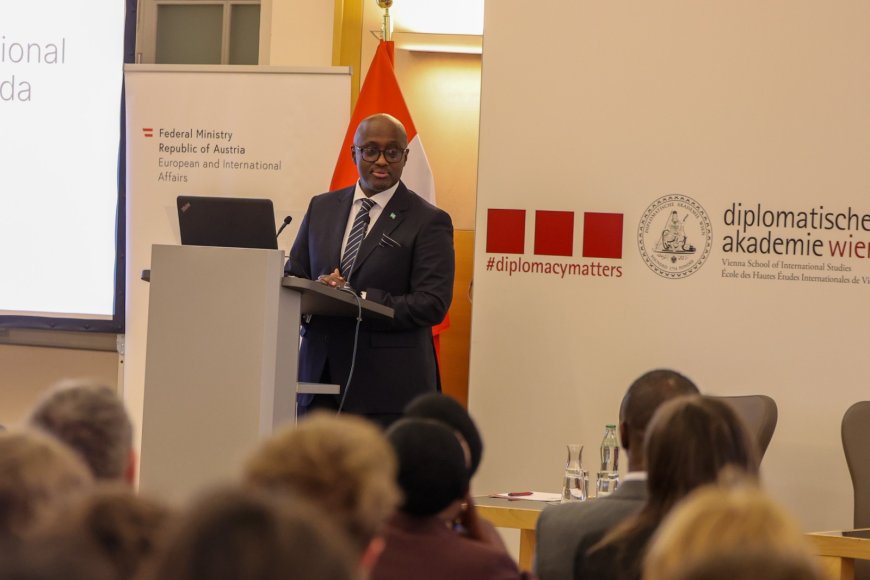
Rwanda’s Minister of Foreign Affairs and International Cooperation, Olivier J.P. Nduhungirehe, warned the international community on Monday that ignoring extremist ideologies in Eastern DR Congo risks a repeat of the 1994 tragedy.
Speaking at the Vienna School of Diplomacy on 23 March, the minister joined global leaders for an international conference under the theme: “Learning from the Past, Shaping the Future: Remembrance, Reconciliation and Reintegration–the 1994 Genocide against the Tutsi in Rwanda.”
The conference, organised by the Austrian Service Abroad in partnership with the Austrian Ministry of Foreign Affairs and the Diplomatic Academy of Vienna, focused on how Rwanda has handled the aftermath of the 1994 Genocide against the Tutsi through justice and education.
During the event, Minister Nduhungirehe raised an alarm over the current security and humanitarian situation in the region.
In Eastern Democratic Republic of Congo, extremist ideologies targeting Tutsi communities, including Banyamulenge, continue to fuel violence, persecution, and displacement,” he stated.
The Minister emphasised that the world must learn from history to prevent future atrocities.
"We must be clear: silence in the face of such warning signs is complicity. We have seen before where denial and indifference can lead. We cannot afford, as International community, to repeat the mistakes of 1994," he told the gathering.
Closing the conference, Urujeni Bakuramutsa, Ambassador and Permanent Representative of Rwanda to the United Nations Offic in Geneva, highlighted that preventing mass violence requires a multi-layered approach.
“Addressing genocide and mass violence requires more than one perspective. It requires different tools working together,” she said.
She noted that history, justice, and early warning signs are essential for accountability.
The Ambassador Bakuramutsa further explained that the true success of Rwanda’s journey lies in community-level healing.
“At the same time, it is within communities, alongside survivors, that this work takes real shape. This is where reconciliation and reintegration take root, and where the social fabric is gradually rebuilt through the slow pace needed for healing,” Bakuramutsa added.