 English
 Kinyarwanda

UN declares slavery ‘gravest crime against humanity’ in landmark reparations vote
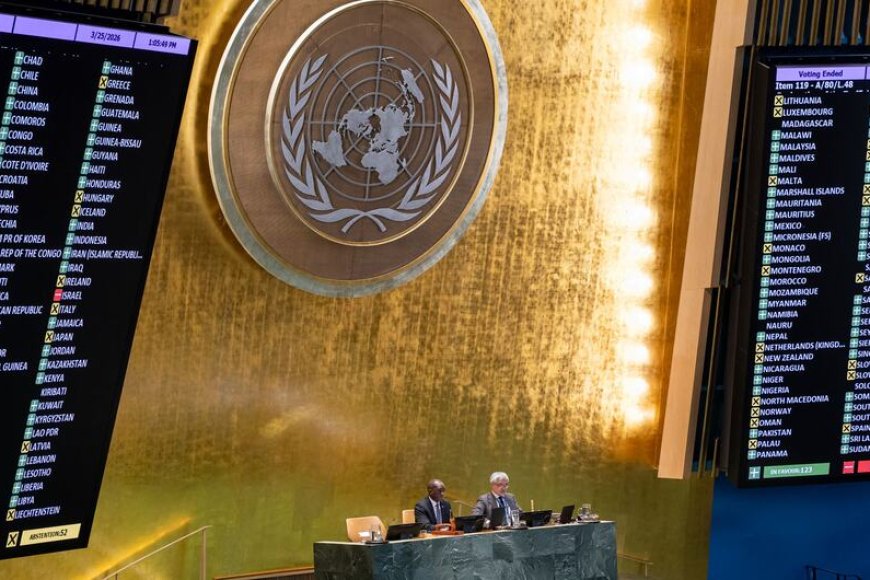
The United Nations General Assembly held on Wednesday, March 25, as Member States adopted a historic resolution officially declaring the transatlantic slave trade the "gravest crime against humanity."
The resolution, A/80/L.48 entitled “Declaration of the Trafficking of Enslaved Africans and Racialized Chattel Enslavement of Africans as the Gravest Crime Against Humanity, has passed with a landslide 123 votes at the UN headquarters in New York.
Spearheaded by Ghana and the 54-member African Group, the declaration marks a turning point in global diplomacy by formally urging reparations to address the "historical wrongs" and enduring legacies of “chattel” slavery.
While the majority of the world supported for reparative justice, the vote saw a divide. Three countries—the United States, Israel, and Argentina—voted against the resolution, while 52 other nations abstained.
“Today, we come together in solemn solidarity to affirm truth and pursue a route to healing and reparative justice,” Ghana’s President John Dramani Mahama told the Assembly ahead of the vote.
Speaking for the African Group, the largest regional bloc at the UN, Mahama called on the world to stand on the "right side of history."
The resolution describes the trafficking of enslaved Africans as a "definitive break in world history."
It highlights the systemic nature and brutality of a trade that, for over 400 years, saw millions of people stolen from Africa, shackled, and shipped across the Atlantic to toil on plantations under the "crack of the whip."
Delegates emphasized that the consequences of this era are not merely historical.
The UN notes that these injustices continue to "structure the lives of all people" today through racialized regimes of property, labor, and capital, manifesting in persistent anti-Black racism and discrimination.
The move for reparations, however, met firm resistance from Washington. Ambassador Dan Negrea, the U.S. representative to the UN Economic and Social Council (ECOSOC), described the text as “highly problematic in countless respects” prior to the vote.
Negrea argued that the United Nations was founded to maintain international peace and security, rather than to "advance narrow specific interests" or "create new costly meeting and reporting mandates."
He further stated that the U.S. “does not recognize a legal right to reparations for historical wrongs that were not illegal under international law at the time they occurred.”
Despite these objections, the atmosphere in the General Assembly Hall remained charged with the commemoration of the International Day of Remembrance of Victims of Slavery.
Assembly President Annalena Baerbock described the slave trade as an "affront to the very principles enshrined in the Charter of our United Nations."
She pointed out that the countries where enslaved people were taken from suffered a "hollowing out," losing entire generations that could have driven domestic prosperity.
“It was, to put it in colder terms, mass resource extraction,” Baerbock said.
UN Secretary-General António Guterres joined the call for action, urging the international community to dismantle the "persistent barriers" that prevent people of African descent from realizing their potential.
He pointed to the Second International Decade for People of African Descent and the African Union’s own Decade of Reparations as vital frameworks for change.
Guterres also called for a shift in global power dynamics, including "commitments to respect African countries’ ownership of their own natural resources" and ensuring their equal influence in the UN Security Council and global financial institutions.
The session intensified as Barbados’ Poet Laureate, Esther Philips shared that of the "spirits of the victims" were present in the room, listening for a single word: justice.
“Because for them and for the world, there can be no peace without justice – reparatory justice – and that call is answered only when words are turned into action,” Philips told the delegates. “The question is, what will you do?”
The African Union Mission to the UN hailed the adoption as a "victory for Africa" and for the ancestors of the millions who suffered.
In a statement following the vote, the Mission declared: “The Decade of Action on Reparations has begun.”