 English
 Kinyarwanda

UN Peacekeeping Troops Drop to 25-Year Low Over Funding, Political Fights

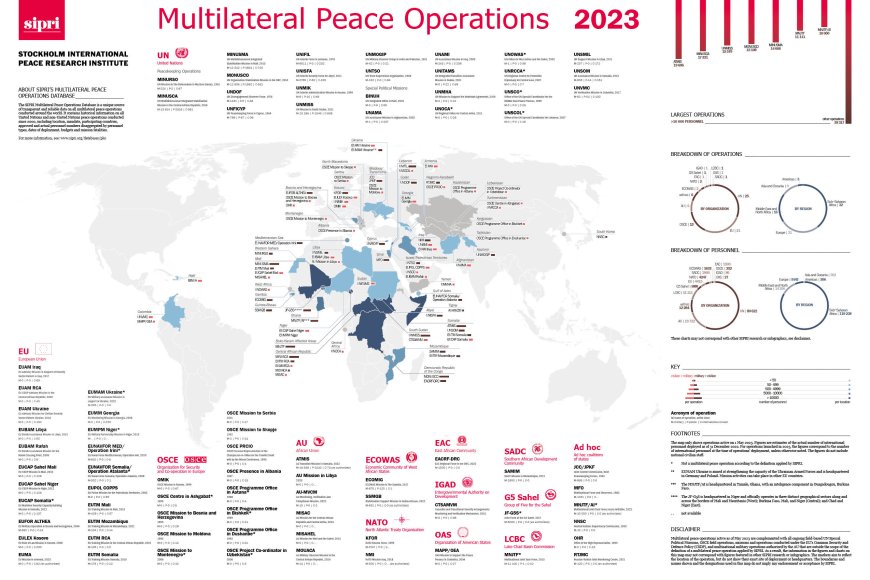
Global peacekeeping troop numbers have crashed to their lowest level in 25 years because countries are refusing to pay their bills and are fighting over politics, according to a new report by the Stockholm International Peace Research Institute (SIPRI) released May 25.
Data from the report titled: Peacekeeping in peril amid plummeting troop numbers and geopolitical deadlock: New SIPRI report, shows that on December 31, 2025, only 78,633 international peacekeepers were working worldwide. This is about half—49 per cent fewer—than the number of troops deployed in 2016.
In 2025 alone, troop numbers fell by 17 per cent, which is the biggest single-year drop since the year 2000.
“‘If things continue in this way, we could see a dramatic weakening of multilateral conflict management and the near-complete sidelining of institutions like the United Nations, due to a perfect storm of funding, political and geopolitical factors,’ said Dr Jaïr van der Lijn, Director of the SIPRI Peace Operations and Conflict Management Programme.
‘The result is likely to be more conflicts, and these conflicts are likely to have even graver impacts on civilians as states abandon long-established norms.’”
The report notes that the main reason for these big troop cuts is a severe cash shortage. This happened because major donor countries failed to pay their promised money on time or in full.
By July 2025, UN peacekeeping operations were missing $2 billion. This deficit was more than 35 per cent of their total $5.6 billion budget, forcing several big missions to make deep cuts to their staff numbers.
At the same time, powerful countries in the UN Security Council are arguing over whether to keep these missions alive. Hardline demands and threats to block decisions have made regular updates to these missions very difficult.
In August 2025, the United States demanded to completely end the UN peacekeeping mission in Lebanon (UNIFIL), even though a 2024 ceasefire agreement was being broken frequently. In the end, the Council made a compromise and voted to keep the mission only until December 2026.
In Haiti, a US-backed plan to turn a temporary security force into an official UN peacekeeping mission failed completely. This happened because China and Russia blocked the plan in the UN Security Council. Instead, the UN had to approve an outside group called the Gang Suppression Force (GSF) to help with security.
Local Groups Cannot Fill the Gap
No new UN-led peacekeeping missions have started since 2014. Local regional groups like the African Union have tried to start their own missions, but they are facing the exact same money shortages and political fights in places like Sudan and Ukraine.
“‘Regional organizations lack key capabilities when it comes to successful, integrated peacebuilding, while they are plagued by funding shortfalls and inability to reach agreement like the UN,’ said Dr Claudia Pfeifer Cruz, Senior Researcher in the SIPRI Peace Operations and Conflict Management Programme.
‘As UN-led conflict management recedes, it is leaving a growing gap that alternative models are unable to fill,’” she added.
Countries Acting Alone
Many countries still say they support peacekeepers in theory. For instance, over 130 countries met in Berlin in May 2025 to talk about the future of peacekeeping, and a new peace plan for Gaza in October 2025 includes a peacekeeping force.
“‘The collapse of multilateral conflict management is not inevitable. There is evidently widespread support for UN peace operations in principle,’ said Claudia Pfeifer Cruz.
“‘However, to sustain multilateral conflict management states will need to go beyond expressions of support—they will need to provide predictable funding and create enough political space to enable effective multilateral responses,’” she cited in a report.
Where Are Peacekeepers Dropping?
In 2025, there were 58 peace missions active in 34 countries, which is three fewer than the year before. Most peacekeepers—73 per cent—are sent to just five missions, and four of those are in Sub-Saharan Africa.
Africa saw the biggest troop cuts, even though it holds 70 per cent of all global peacekeepers.
Two new missions started in 2025 to replace old ones: the African Union Support and Stabilization Mission in Somalia (AUSSOM) and the Gang Suppression Force in Haiti. Meanwhile, four missions closed down completely in the Democratic Republic of the Congo, Haiti, Iraq, and the Nagorno-Karabakh region.
The report also shows that the top 10 countries sending military troops are all from the Global South. Uganda is now the number one troop contributor, followed by Nepal, Bangladesh, and India.
Other top contributors include Rwanda, Ethiopia, Burundi, Kenya, Pakistan, and Indonesia.