 English
 Kinyarwanda

AU Welcomes Deal to End 50-Year Equatorial Guinea-Gabon Border Dispute

The African Union (AU) has welcomed a deal between Equatorial Guinea and Gabon to implement an International Court of Justice (ICJ) ruling, a move aimed at ending a 50-year territorial and maritime border dispute.
The dispute between Equatorial Guinea and Gabon is a territorial and maritime border dispute, mainly over three small islands in the Gulf of Guinea and the surrounding waters, which are believed to be rich in oil and gas.
The main disputed islands are: Mbanié, Cocotiers, and Conga Island.
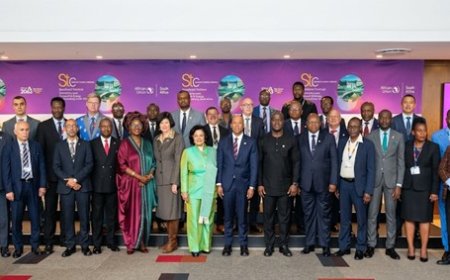
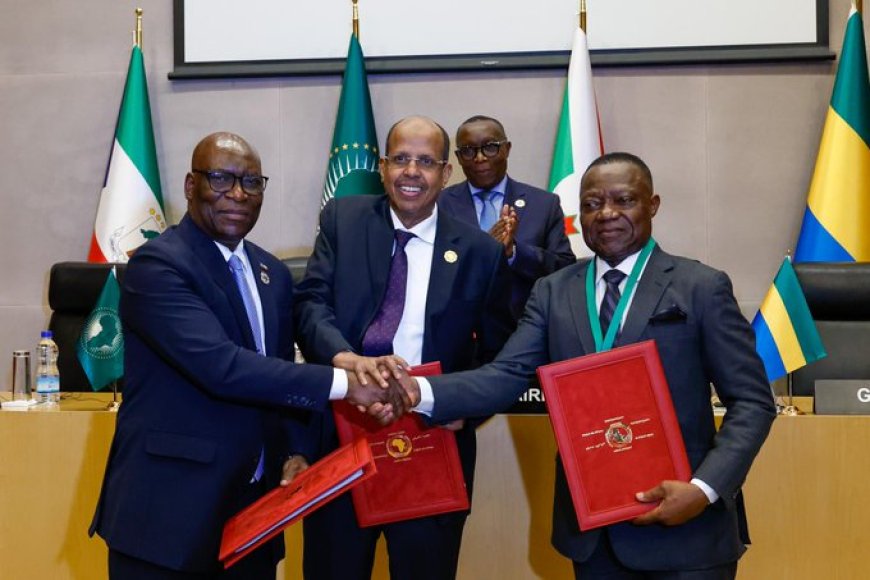
The Joint Engagement Agreement was signed on the sidelines of the 49th Ordinary Session of the AU Executive Council in Addis Ababa, took place on July 28.
The accord outlines how the two countries will implement the ICJ judgment issued on May 19, 2025, ending years of disagreement over their territorial issues.
The agreement was signed by Equatorial Guinea's Minister of Foreign Affairs, International Cooperation and the Diaspora, Simeon Oyono Esono Angue, and Gabon's President of the Constitutional Court, Dieudonné Aba’a Owono.
The ceremony was witnessed by African Union Commission Chairperson Mahmoud Ali Youssouf and Burundi's Foreign Minister Edouard Bizimana, who chairs the AU Executive Council.
The signing follows a high-level meeting facilitated by the AU Commission Chairperson, where Equatorial Guinea President Teodoro Obiang Nguema Mbasogo and Gabon President Brice Clotaire Oligui Nguema reaffirmed their commitment to peacefully implementing the ICJ ruling under the African Union's guidance.
To advance the process, Youssouf appointed Burundi's Ambassador Albert Shingiro as his Special Envoy to maintain dialogue between the two countries.
Addressing the signing ceremony, Youssouf praised both governments for choosing dialogue over conflict.
“The Agreement reflects a shared commitment to dialogue, cooperation, good neighbourliness and the peaceful resolution of disputes in the spirit of African unity,” said the Chairperson,” said the Chairperson.
Speaking on behalf of Gabon, Dieudonné Aba’a Owono described the agreement as more than a legal document.
“Beyond the legal significance of this Agreement, we view it as an act of mutual trust and a strong political commitment towards the preservation of peace in Central Africa. In a continental context marked by multiple security challenges, this approach demonstrates that dialogue and cooperation remain the most effective instruments for preventing tensions.”
Equatorial Guinea's Foreign Minister Simeon Oyono Esono Angue said both countries had a responsibility to demonstrate that international disputes can be resolved peacefully.
“We bear the historic responsibility of demonstrating that neighbouring States can implement an international judicial decision with composure, responsibility and good faith, while maintaining full respect for both international and African institutions. Africa is watching us. The world is watching us. Our people are watching us.”
Burundi's Foreign Minister Edouard Bizimana said the agreement reflected the political will of both countries to resolve differences peacefully.
“The Agreement signed today is much more than a legal instrument. It is a testament to the political maturity of two African Nations that have chosen dialogue over confrontation, cooperation over division, and respect for the rule of law over the use of force.”