
Kagame cites ‘undeniable’ evidence to confront rising genocide denial at Kwibuka32
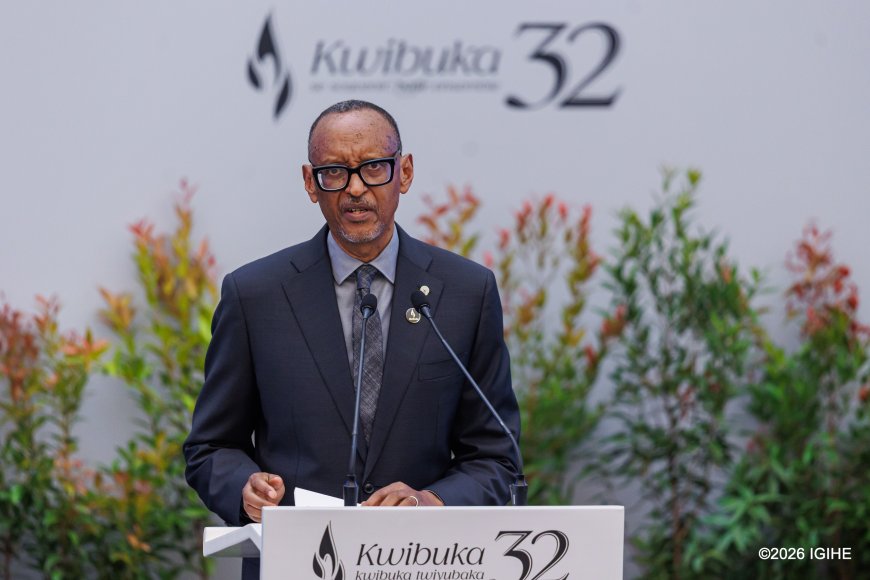
President Paul Kagame delivering remarks during the Kwibuka 32 ceremony at the Kigali Genocide Memorial-Gisozi on Tuesday, April 7, noting that the 1994 Genocide against the Tutsi was a planned state project rather than a spontaneous event.

Kagame cites ‘undeniable’ evidence to confront rising genocide denial at Kwibuka32

Apr 7, 2026 - 16:05
 0

President Paul Kagame on Tuesday, April 7, has reaffirmed the historical certainty of the 1994 Genocide against the Tutsi, warning that modern attempts to distort these facts are a deliberate and dangerous political strategy.


Speaking at the Kigali Genocide Memorial-Gisozi during the 32nd Commemoration, Kagame highlighted a massive body of evidence—including 50 million handwritten Gacaca records—as proof that the tragedy was a meticulously planned state project rather than a spontaneous event.

The President told Rwandans, friends of Rwanda and international guests that confronting “denialism” is essential for national survival.

He noted that the “twisting of facts” seen today mirrors the same tactics used by the genocide’s original planners to dehumanidr victims.

“The reality of the genocide is clear for all to see,” Kagame stated. “The ringleaders were convicted in international courts with rigorous evidence. The Gacaca process documented the cause of the genocide in every single village and neighbourhood in Rwanda.”

To illustrate the scale of this documentation, the President pointed to the 10-year Gacaca process, which produced over 50 million handwritten pages of testimony.

He noted that these records, combined with a quarter of a million victims of the genocide laid to rest at the Gisozi memorial, form an undeniable archive of the truth.

Kagame emphasised that the global community has formally recognised this reality. He cited the 2018 United Nations General Assembly resolution that officially termed the event the ‘Genocide against the Tutsi’ as proper name.

“The truth is undeniable,” Kagame said. “And yet, we still find people sowing doubt and twisting the facts up to today.”

The President argued that this trend is not caused by a lack of information. Instead, he framed it as a “deeper” issue where history is manipulated for political gain.

He warned that “genocide denial begins long before the genocide itself is committed.” He described a recurring pattern where hate speech is dismissed as “popular discontent” and early warning signs are ignored or rationalised.

Kagame was particularly critical of those who attempt to create a “moral equivalence” between the victims and the perpetrators.

He noted that even some individuals who were eyewitnesses to the killings have since become “peddlers of distortion” for political reasons.

The speech detailed the long-term preparations for the massacres, reaching back to the early 1960s and the pattern continued in the late 1980s and early 1990s, when Tutsi communities such as the Bagogwe in the northwest were targeted in organised attacks.

“There are some who pretend that the genocide against the Tutsi was a spontaneous event. That's not true. It was carefully prepared and carried out in plain sight,” the President said.

By centering the story on the massive volume of physical and legal evidence, Kagame reminded the audience that memory is a form of defense.

He noted that Rwandans must continue to use their voices to speak up when history is misrepresented.

“You can never silence us in whatever form,” he said, reiterating that the power to see the truth is what sustains the nation’s unity.

Kagame cites ‘undeniable’ evidence to confront rising genocide denial at Kwibuka32

Apr 7, 2026 - 16:05
Apr 7, 2026 - 18:49
 0
Kagame cites ‘undeniable’ evidence to confront rising genocide denial at Kwibuka32
President Paul Kagame delivering remarks during the Kwibuka 32 ceremony at the Kigali Genocide Memorial-Gisozi on Tuesday, April 7, noting that the 1994 Genocide against the Tutsi was a planned state project rather than a spontaneous event.

President Paul Kagame on Tuesday, April 7, has reaffirmed the historical certainty of the 1994 Genocide against the Tutsi, warning that modern attempts to distort these facts are a deliberate and dangerous political strategy.


Speaking at the Kigali Genocide Memorial-Gisozi during the 32nd Commemoration, Kagame highlighted a massive body of evidence—including 50 million handwritten Gacaca records—as proof that the tragedy was a meticulously planned state project rather than a spontaneous event.

The President told Rwandans, friends of Rwanda and international guests that confronting “denialism” is essential for national survival.

He noted that the “twisting of facts” seen today mirrors the same tactics used by the genocide’s original planners to dehumanidr victims.

“The reality of the genocide is clear for all to see,” Kagame stated. “The ringleaders were convicted in international courts with rigorous evidence. The Gacaca process documented the cause of the genocide in every single village and neighbourhood in Rwanda.”

To illustrate the scale of this documentation, the President pointed to the 10-year Gacaca process, which produced over 50 million handwritten pages of testimony.

He noted that these records, combined with a quarter of a million victims of the genocide laid to rest at the Gisozi memorial, form an undeniable archive of the truth.

Kagame emphasised that the global community has formally recognised this reality. He cited the 2018 United Nations General Assembly resolution that officially termed the event the ‘Genocide against the Tutsi’ as proper name.

“The truth is undeniable,” Kagame said. “And yet, we still find people sowing doubt and twisting the facts up to today.”

The President argued that this trend is not caused by a lack of information. Instead, he framed it as a “deeper” issue where history is manipulated for political gain.

He warned that “genocide denial begins long before the genocide itself is committed.” He described a recurring pattern where hate speech is dismissed as “popular discontent” and early warning signs are ignored or rationalised.

Kagame was particularly critical of those who attempt to create a “moral equivalence” between the victims and the perpetrators.

He noted that even some individuals who were eyewitnesses to the killings have since become “peddlers of distortion” for political reasons.

The speech detailed the long-term preparations for the massacres, reaching back to the early 1960s and the pattern continued in the late 1980s and early 1990s, when Tutsi communities such as the Bagogwe in the northwest were targeted in organised attacks.

“There are some who pretend that the genocide against the Tutsi was a spontaneous event. That's not true. It was carefully prepared and carried out in plain sight,” the President said.

By centering the story on the massive volume of physical and legal evidence, Kagame reminded the audience that memory is a form of defense.

He noted that Rwandans must continue to use their voices to speak up when history is misrepresented.

“You can never silence us in whatever form,” he said, reiterating that the power to see the truth is what sustains the nation’s unity.