
Kagame criticizes global community for not caring, says lives were seen as worthless in 1994
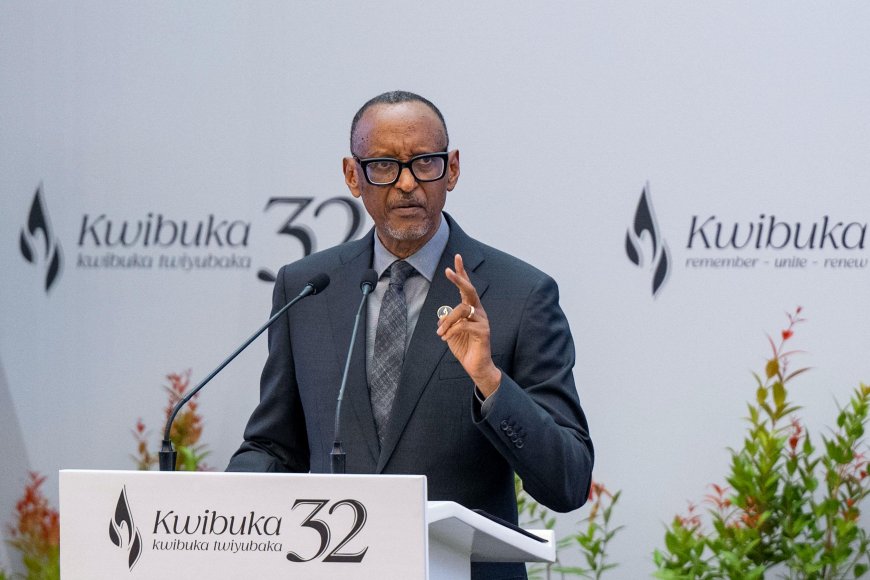
President Paul Kagame Kwibuka32 ceremony at the Kigali Genocide Memorial-Gisozi on Tuesday, April 7, revealed how the world failed to help during the 1994 Genocide against Tutsi in Rwanda.

Kagame criticizes global community for not caring, says lives were seen as worthless in 1994

Apr 7, 2026 - 17:31
 0

President Paul Kagame has blamed the world for failing to intervene during the 1994 Genocide against the Tutsi. Speaking at the Kwibuka32 ceremony, he said that global community ignored the killings because they did not value the lives of Rwandans at the time.


During the 32nd Commemoration at the Kigali Genocide Memorial, Gisozi, on Tuesday, April 7, the President detailed how the United Nations ignored specific intelligence and withdrew peacekeepers at the height of the killing. 

He argued that this historical “moral passivity” continues to plague regional and continental institutions today.

“In the end, the operation was deemed to be too expensive and potentially also a violation of Rwanda's sovereignty,” Kagame said. “So the cost became too expensive. It was more expensive, especially when in their minds those lives are really worthless. So our lives were worth nothing. That’s fine.”

Kagame recounted the specific timeline of institutional failure, noting that as early as January 1994, the UN Mission in Rwanda sent a detailed fax to New York. The intelligence warned of weapon stockpiles and lists of Tutsis to be killed.

The response from UN headquarters, Kagame noted, “it was then ordered to share the information with the very government which was preparing the genocide and to take no further action.”

The President highlighted the tragedy at ETO Kicukiro as a symbol of global desertion. He reminded the audience that when peacekeepers withdrew to evacuate foreigners, thousands of desperate Tutsis were left behind to face death.

“If these forces had stayed, been supported to protect Rwandans, the killers would have been deterred and many people would still be alive,” he said.

Kagame extended his critique to the current state of African affairs, calling for a shift in how the continent views its own security.

He argued that while “African sovereignty” is a legitimate principle, it should never be used as a shield for bad actors to evade responsibility for human rights abuses.

“I say this because the call for African sovereignty, legitimate and necessary as it is, must also mean that African institutions act decisively when Africans are at risk,” Kagame stated.

He further warned that “genocide ideology is still spreading in our region. Left unchecked, it has the power to take us all backwards again. There are those who claim that Rwanda exaggerates these concerns or that we have ulterior motives.”

The President emphasised that Rwandans have learned they cannot rely on outside interests for their survival.

He noted that the lessons of 1994 were “brutal” and “Rwandans understand the cost of tolerating extremism and our central security principle is to put the protection of civilians first.”

Kagame criticizes global community for not caring, says lives were seen as worthless in 1994

Apr 7, 2026 - 17:31
Apr 7, 2026 - 19:23
 0
Kagame criticizes global community for not caring, says lives were seen as worthless in 1994
President Paul Kagame Kwibuka32 ceremony at the Kigali Genocide Memorial-Gisozi on Tuesday, April 7, revealed how the world failed to help during the 1994 Genocide against Tutsi in Rwanda.

President Paul Kagame has blamed the world for failing to intervene during the 1994 Genocide against the Tutsi. Speaking at the Kwibuka32 ceremony, he said that global community ignored the killings because they did not value the lives of Rwandans at the time.


During the 32nd Commemoration at the Kigali Genocide Memorial, Gisozi, on Tuesday, April 7, the President detailed how the United Nations ignored specific intelligence and withdrew peacekeepers at the height of the killing. 

He argued that this historical “moral passivity” continues to plague regional and continental institutions today.

“In the end, the operation was deemed to be too expensive and potentially also a violation of Rwanda's sovereignty,” Kagame said. “So the cost became too expensive. It was more expensive, especially when in their minds those lives are really worthless. So our lives were worth nothing. That’s fine.”

Kagame recounted the specific timeline of institutional failure, noting that as early as January 1994, the UN Mission in Rwanda sent a detailed fax to New York. The intelligence warned of weapon stockpiles and lists of Tutsis to be killed.

The response from UN headquarters, Kagame noted, “it was then ordered to share the information with the very government which was preparing the genocide and to take no further action.”

The President highlighted the tragedy at ETO Kicukiro as a symbol of global desertion. He reminded the audience that when peacekeepers withdrew to evacuate foreigners, thousands of desperate Tutsis were left behind to face death.

“If these forces had stayed, been supported to protect Rwandans, the killers would have been deterred and many people would still be alive,” he said.

Kagame extended his critique to the current state of African affairs, calling for a shift in how the continent views its own security.

He argued that while “African sovereignty” is a legitimate principle, it should never be used as a shield for bad actors to evade responsibility for human rights abuses.

“I say this because the call for African sovereignty, legitimate and necessary as it is, must also mean that African institutions act decisively when Africans are at risk,” Kagame stated.

He further warned that “genocide ideology is still spreading in our region. Left unchecked, it has the power to take us all backwards again. There are those who claim that Rwanda exaggerates these concerns or that we have ulterior motives.”

The President emphasised that Rwandans have learned they cannot rely on outside interests for their survival.

He noted that the lessons of 1994 were “brutal” and “Rwandans understand the cost of tolerating extremism and our central security principle is to put the protection of civilians first.”