 English
 Kinyarwanda
Kwibuka32: “Genocide cannot happen here again,” Kagame says
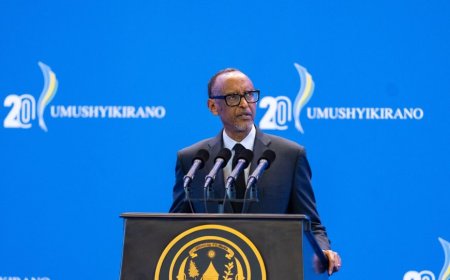
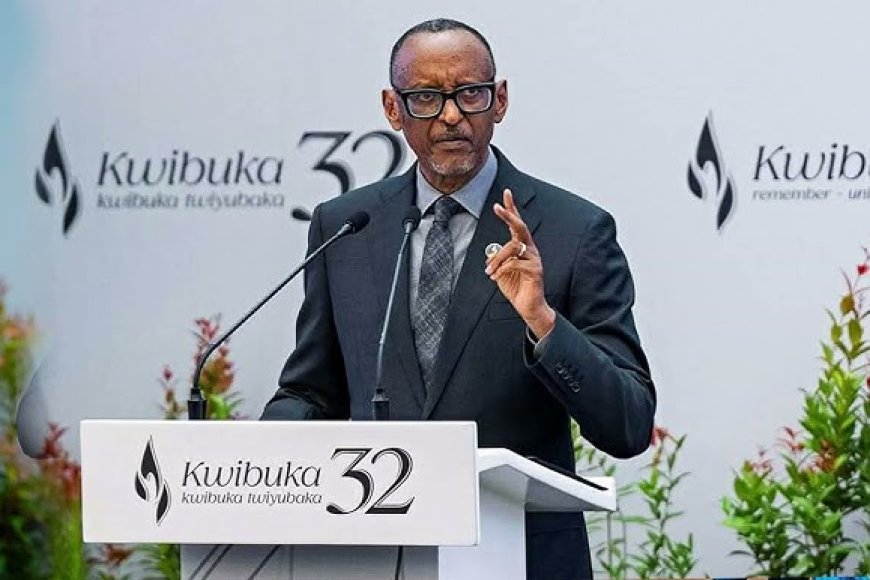
The President Paul Kagame has said that, “I tell you, genocide cannot happen here again. It won't happen,” linking the country’s 1994 tragedy to current security threats along its western border.
Addressing the audience at the Kigali Genocide Memorial-Gisozi during 32nd Commemoration, on Tuesday, April 7, the President declared that Rwanda’s security is non-negotiable.
He dismissed regional tensions and external criticisms as “noise,” asserting that the nation’s defense forces are fully prepared to prevent a repeat of history.
Paul Kagame warned that Rwanda will never again allow the politics of division and hate that led to the 1994 Genocide against the Tutsi to take root.
“After the genocide, Rwandans chose to rebuild our country together,” Kagame noted. “With that came a promise to never let the politics of genocide take root ever again.”
“And I'm saying this not just as a person. I'm saying it because I know everyone, young and old, is determined and saying so like I'm saying it now to you,” he added.
The President’s remarks come amid rising concerns over the Democratic Forces for the Liberation of Rwanda (FDLR), a militia founded by individuals linked to the perpetrators of the 1994 Genocide against the Tutsi, as well as other armed groups operating in the region.
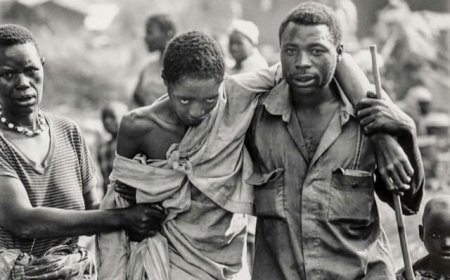
Paul Kagame traced the roots of the current instability back to July 1994, when the genocidal government and its militias fled across the border into the Democratic Republic of the Congo (DRC).
He recalled that these forces reorganized in refugee camps, from where they launched the “Abacengezi” insurgency—an armed campaign that claimed tens of thousands of lives in the late 1990s.
Kagame noted that security along Rwanda’s western border was ultimately restored through the combined efforts of the national army and local communities.
“Since then, our defensive measures have been aimed at ensuring that such attacks can never again be launched from across our borders,” he said.
Addressing ongoing regional meetings and political mobilization involving actors in Kinshasa and Europe, the President was dismissive. He described these developments as a continuation of a failed and dangerous ideology, emphasizing that it would not be allowed to take root on Rwandan soil.
“Even with those noises you hear in the region of people gathering from Europe, from wherever, and meeting in Kinshasa... all of that is just noise. It cannot amount to anything that will happen here of that kind again,” Kagame said.
The President also defended the character and reputation of the Rwanda Defence Forces (RDF).
He noted that the military’s identity was “forged in those dramatic moments” when the Rwandan Patriotic Army (RPA) had to stop the genocide alone.
He emphasized that this history guides the RDF's current conduct in international peace-building missions.
Kagame signaled a firm stance against international pressure, specifically addressing the issue of sanctions directed at Rwanda’s security apparatus.
“Indeed, no sanctions or insult from outside can ever tarnish the honour and integrity of Rwanda's Defence and Security Forces who are among the finest that can be found anywhere,” he stated.
He added that he intends to raise the matter of sanctions “at the highest level to understand the basis for such an injustice.”
Kagame argued that Rwanda is often “penalised for standing up for itself.”
He also warned that genocide ideology is still spreading in the region and cannot be ignored.
The President stated, the unity of Rwandans is the nation's shield. He noted that the country’s central security principle remains the protection of civilians, a lesson learned through the “brutal” reality of being abandoned by the world in 1994.
“What sustains Rwanda today is the unity of Rwandans and the convictions that like all people, we have the right to live in safety and dignity,” he said.
“We owe future generations of Rwandans more than survival. They deserve to inherit a secure, united and bold country and an integrated and confident Africa.”