 English
 Kinyarwanda

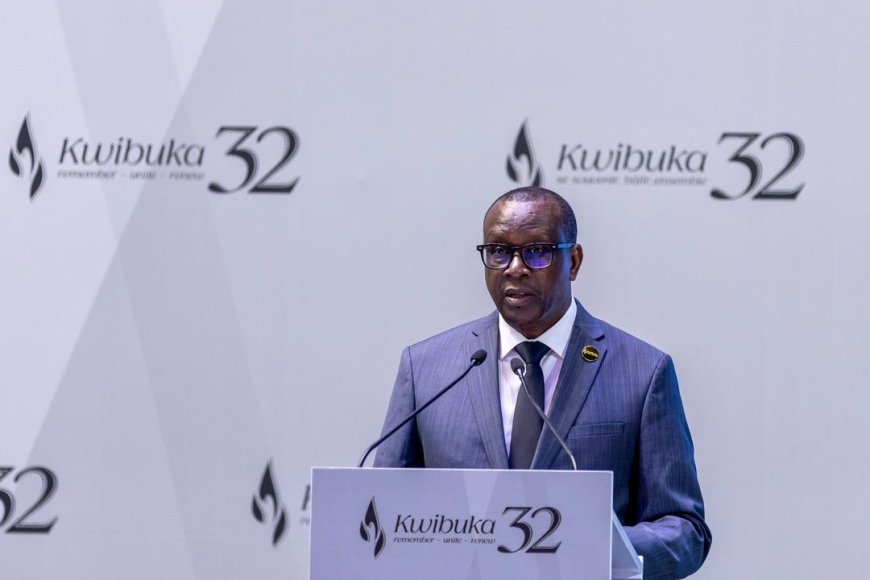
Minister Bizimana denounces African ‘indifference’ at International Conference on Genocide Prevention

Dr. Jean Damascène Bizimana, Rwanda’s Minister of National Unity and Civic Engagement, called for an immediate end to international “indifference” and “complicity” regarding the persistence of genocide ideology during a high-profile conference on Wednesday, April 8, as Rwanda marks the 32nd Commemoration of the 1994 Genocide against the Tutsi.
Speaking at the International Conference on Genocide Prevention at Intare Arena in Kigali, which brought together hundreds of researchers, academics, survivors, and friends of Rwanda, the Minister said the gathering aimed to remember, reflect, and reaffirm a shared commitment to confronting genocide ideology and hate speech.
He mentioned the Democratic Republic of Congo (DRC) for what he described as the “public and direct” promotion of genocidal ideology through its support of the FDLR.
Minister Bizimana opened the session by honoring the 30-year legacy of Ibuka, the umbrella organization for genocide survivors. He credited the group’s “pioneers” for playing a key role in the resilience of those who survived the horror.
“After yesterday, which plunged us into a period of solemn reflection where we paid a well-deserved tribute to the victims, we meet this morning for this scientific conference to reflect on the challenges related to memory,” Bizimana stated.
The Minister emphasized the historical uniqueness of the 1994 Genocide against the Tutsi, noting it was the first genocide recognized by the United Nations on the African continent since the 1948 Convention.
He reminded the audience that the International Criminal Tribunal for Rwanda (ICTR) established the genocide as a matter of “public international notoriety” in 2006.
“It is a sad 'pioneer' position that Africa has taken by allowing the first genocide on its soil,” he said.
A significant portion of the address focused on the “indifference of Africa” regarding the prosecution of suspects.
“For 32 years, not a single African state has brought to trial on its territory a single perpetrator of the genocide committed against the Tutsi, despite the abundance of international arrest warrants sent by Rwanda to various states hosting suspects.
The Minister then turned his attention to the current security crisis in the Great Lakes region. He accused the DRC government of integrating the FDLR—a group founded by the perpetrators of the 1994 genocide—into its national army.
“The DRC clearly displays a genocidal policy and proves it by integrating these 'tropical Nazis'—the FDLR—into its own army,” Bizimana said.
He criticized DRC spokesperson Patrick Muyaya and other officials for “denying responsibility” and justifying their alliance with the militia.
He Warned that the current rhetoric in the region mirrors the four-year planning period that preceded the 1994 genocide, the Minister called for scientific and legal accountability rather than political compromise.
“This colloquium is the moment to say: we see, we observe, we know, and we denounce,” Bizimana concluded. “We say 'stop' to the blindness, the compromises, the indifference, and the complicity.”