South Sudan Demands End to Ebola Travel Restrictions
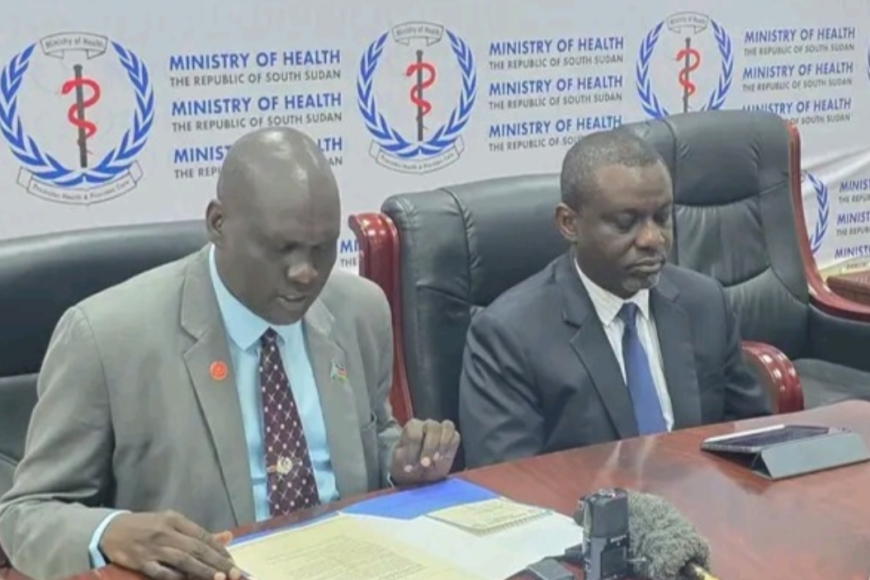
Health Ministry Undersecretary Dr. Oromo Francis and WHO Representative Dr. Humphrey Karamagi brief the media on South Sudan's Ebola preparedness during a joint press conference in Juba on Friday, June 26. Photo: Courtesy

South Sudan Demands End to Ebola Travel Restrictions

Jun 27, 2026 - 09:21
 0

The government of South Sudan on Friday, June 26 demanded that foreign nations lift Ebola-related travel and visa bans on its citizens, warning that the restrictions are blocking medical travel and causing preventable deaths.


Speaking at a joint press conference with the World Health Organization (WHO) in Juba, Health Ministry Undersecretary Francis Oromo stressed that the bans are actively harming individuals who need to travel abroad for critical medical treatment and education.

"There is no Ebola here. No one is dying here. But people are now dying because they are unable to travel abroad for medical treatment," Oromo said.

Health authorities confirmed that South Sudan has zero confirmed cases of the virus. All seven suspected Ebola cases identified nationwide—including four tracked in the capital city of Juba—have officially tested negative.

South Sudan launched a swift emergency response plan immediately after outbreaks were reported in neighboring countries. As part of this defense strategy, the health ministry deployed specialized response teams to high-risk states, strengthened border surveillance, and expanded isolation ward capacity.

Because of heavy cross-border movement and its proximity to affected areas, the country remains at risk. To mitigate this, health officials are collaborating closely with neighboring countries, regional health bodies, and international partners to share real-time information and strengthen disease tracking.

WHO Representative in South Sudan Humphrey Karamagi confirmed the country remains entirely Ebola-free. He noted that the successful detection and investigation of the previous suspected cases prove the national surveillance system is working effectively.

"From a scientific point of view, WHO does not recommend border closures or travel restrictions," Karamagi said.
South Sudan Demands End to Ebola Travel Restrictions

Jun 27, 2026 - 09:21
Jun 27, 2026 - 09:22
 0
South Sudan Demands End to Ebola Travel Restrictions
Health Ministry Undersecretary Dr. Oromo Francis and WHO Representative Dr. Humphrey Karamagi brief the media on South Sudan's Ebola preparedness during a joint press conference in Juba on Friday, June 26. Photo: Courtesy

The government of South Sudan on Friday, June 26 demanded that foreign nations lift Ebola-related travel and visa bans on its citizens, warning that the restrictions are blocking medical travel and causing preventable deaths.


Speaking at a joint press conference with the World Health Organization (WHO) in Juba, Health Ministry Undersecretary Francis Oromo stressed that the bans are actively harming individuals who need to travel abroad for critical medical treatment and education.

"There is no Ebola here. No one is dying here. But people are now dying because they are unable to travel abroad for medical treatment," Oromo said.

Health authorities confirmed that South Sudan has zero confirmed cases of the virus. All seven suspected Ebola cases identified nationwide—including four tracked in the capital city of Juba—have officially tested negative.

South Sudan launched a swift emergency response plan immediately after outbreaks were reported in neighboring countries. As part of this defense strategy, the health ministry deployed specialized response teams to high-risk states, strengthened border surveillance, and expanded isolation ward capacity.

Because of heavy cross-border movement and its proximity to affected areas, the country remains at risk. To mitigate this, health officials are collaborating closely with neighboring countries, regional health bodies, and international partners to share real-time information and strengthen disease tracking.

WHO Representative in South Sudan Humphrey Karamagi confirmed the country remains entirely Ebola-free. He noted that the successful detection and investigation of the previous suspected cases prove the national surveillance system is working effectively.

"From a scientific point of view, WHO does not recommend border closures or travel restrictions," Karamagi said.