 English
 Kinyarwanda

We expected him to save us, survivor recalls for Pastor Jean Uwinkindi’s atrocities at Ntarama

Coletha Akaniwabo still remembers the day she stopped being a student and became a target. It began in a primary school classroom in Mwogo Sector, eastern Rwanda where teachers forced Tutsi children to stand and endure beatings while being called “Kigozi”—a name for the wooden cups used to milk cows.
“I did not know whether I was Tutsi or Hutu,” Akaniwabo recalled. “All children would bring food and we would share without mentioning whether it came from a Tutsi or Hutu family.” That innocence horrified when her teachers told her to go home and ask her parents why she was different.
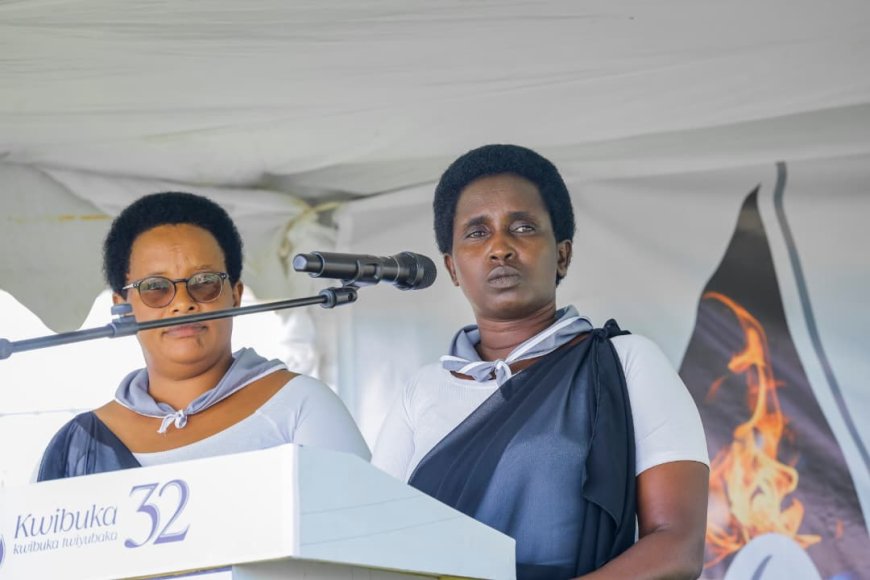
On Wednesday, April 15, that long history of discrimination and the violence that followed was marked with solemn dignity. Akaniwabo joined thousands of mourners at the Ntarama Genocide Memorial, Bugesera District to accord a decent burial to 154 victims of the 1994 Genocide against the Tutsi.
The remains were recently recovered from across Bugesera District, with 148 found in Mwogo Sector alone.
The ceremony, held as part of the 32nd commemoration, turned the former Catholic church of Ntarama into a site of both grief and historical reckoning.
For survivors like Akaniwabo, the only survivor among seven siblings, the day was a painful reminder of how those they trusted most became their executioners.
As the Interahamwe militia intensified their attacks in April 1994, Akaniwabo, who was pregnant at the time, fled toward the church in Nyamata. She was part of a group of roughly 10,000 people hoping that men of God would offer them sanctuary.
Instead, they encountered Pastor Jean Uwinkindi at the Pentecostal Church of Kayenzi.
“We expected him to save us, but instead we experienced tragedy,” Akaniwabo said. She described a scene of calculated deception that continues to haunt survivors.
Uwinkindi, who is currently serving a life sentence at Nyanza Correctional Facility for genocide and crimes against humanity, distributed white baptismal robes to the Interahamwe militia.
The killers put on the clothes of the faithful to get close to the victims. “They appeared like men of God who would save us,” she said. “The Interahamwe hid machetes inside those clothes and suddenly began killing us.”
Akaniwabo recounted how a young man named Karuranga was forced by the militia to dump the bodies of his own relatives before he, too, was murdered.
The court later found that Uwinkindi led these attacks at Rwankeri and Kanzenze Hills, trapping between 100 and 150 Tutsi who had sought refuge at his church.
The path to Nyamata was a landscape of horrors. Akaniwabo remembers passing Karambi Primary School, where the bodies of the fallen were so numerous that vultures had begun to descend. Even her former classmates stood by the roadside, watching the slaughter without moving to help.
The intervention of the RPA-Inkotanyi at Kayumba Hill finally brought an end to the running. “We regained hope after being rescued and taken to a camp,” she said.
Thirty-two years later, the woman who once fled through the bush while pregnant has rebuilt her life. Now a model rice farmer, Akaniwabo has raised six children and is a grandmother to two.
While her husband’s body remains lost to the river after he was killed at Rukira Church, she finds a sense of healing in the burials at Ntarama.
“I spent many years without interacting with others because we did not know the whereabouts of our relatives who had been dumped,” Akaniwabo said. “Today, I am healing, and I am happy that more survivors are recovering the remains of their loved ones for a decent burial.”