 English
 Kinyarwanda
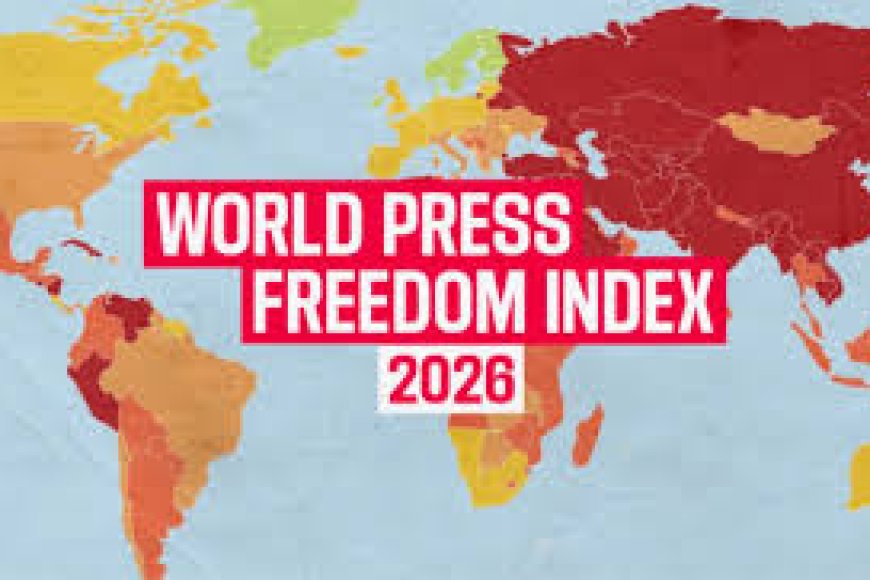
Global Press Freedom Hits 25-Year Low as Journalism Suffocates

For the first time in a quarter-century, the global state of press freedom has hit an all-time low, with over half of the world’s nations now categorised as "difficult" or "very serious" environments for reporters.
The 2026 World Press Freedom Index (WPFI) released by Reporters Without Borders (RSF)-a Paris-based non-governmental organisation paints a picture of a planet where the right to information is being dismantled by legal warfare, physical violence, and political hostility.
ALSO READ: UN Warns Press Freedom Under New pressure as 85% of Crimes Go Unpunished
The WPFI-an annual ranking of 180 countries and territories measures the level of freedom available to journalists.
The comprehensive study reveals that the average global score has never been lower since the Index began in 2001, noted in RSF 2026 index.
ALSO READ: Global Freedom of Expression Declines 10% Since 2012- UNESCO
According to the organisation, this year’s decline is driven largely by the “criminalisation of journalism,” as governments increasingly misuse national security laws to silence those who investigate power.
The report highlights a world turning worse each year, leaving less than 1 per cent of the global population living in a country where the state of press freedom is considered “good.”
From the ongoing killing of journalists in Gaza to the decline of the United States, the index warns that the foundations of democratic transparency are disintegrating.
“How much longer will we tolerate the suffocation of journalism, the systematic obstruction of reporters and the continued erosion of press freedom?” asked RSF Editorial Director Anne Bocandé in an assessment of the data.
The decline is most visible in the Index’s “legal indicator,”-how a country’s laws and justice system affect the media-which fell in 110 of the 180 countries surveyed.
RSF researchers found that the expansion of “defense secrets” and “national security” policies—often birthed in the wake of 9/11—are now being weaponised even within established democracies.
“Authoritarian states, complicit or incompetent political powers, predatory economic actors and under-regulated online platforms are directly and overwhelmingly responsible for the global decline in press freedom,” Bocandé stated.
She emphasised that “inaction is a form of endorsement,” calling for an immediate end to the misuse of SLAPPs and anti-terror laws.
In the Americas, the landscape has shifted violently.
The United States dropped seven places to 64th, a decline attributed to President Donald Trump’s systematic policy of attacking the press, RSF index shows.
The RSF also cites the detention and deportation of Salvadoran journalist Mario Guevara and drastic cuts to the U.S. Agency for Global Media (USAGM) as factors that have weakened global media safety nets.
This “Trump-style” approach to the media has spread across Latin America.
Argentina, under Javier Milei, fell 11 places, while Nayib Bukele’s El Salvador dropped 105 places since 2014, currently sitting at 143rd. In countries like Ecuador (125th, -31) and Peru (144th, -14).
The human cost of this decline is perhaps most visible in the Middle East.
Since October 2023, more than 220 journalists have been killed in Gaza by the Israeli army, with at least 70 killed specifically while carrying out their work.
This violence has seen Israel drop four places in the ranking, while neighboring nations like Iraq (162nd), Sudan (161st) and Yemen (164th) remain trapped in the “very serious” category due to recurring armed conflicts.
In Eastern Europe, Vladimir Putin’s Russia continues to set the standard for repression, according to the report.
Currently ranked 172nd, Russia is utilising laws “designed to combat terrorism, separatism and extremism to restrict press freedom. As of April 2026, the country held 48 journalists behind bars.” This legal persecution now extends beyond its borders, targeting journalists even in exile.
The index details that Hong Kong has fell 122 places since Beijing tightened control, recently sentencing publisher Jimmy Lai to 20 years in prison. Meanwhile, in Japan, state secrets legislation continues to undermine the confidentiality of sources, pushing the democracy down to 62nd place.
Syria also recorded the biggest improvement in the world, climbing 36 places from 177th. The fall of Bashar al-Assad’s dictatorship in December 2024 and the subsequent political transition, after years as one of the bottom ten countries in the Index.
Norway remains the global leader, holding the top spot for the tenth consecutive year, followed by the Czech Republic and Lithuania.
On the opposite end of the spectrum, Eritrea remains the world’s worst environment for press freedom, marking its third year at the very bottom of the Index (180th), stated RSF index.
RSF notes that the current protection mechanisms are no longer enough to stop the tough.
“The ball is in the court of democracies and their citizens,” Bocandé warned.
“It is up to them to stand in the way of those who seek to silence the press. The spread of authoritarianism isn’t inevitable.